
5 Talent Acquisition Trends Shaping 2027: SorsX Founder AJ Faraj Joins SHRM to Discuss the Future of Hiring
Artificial intelligence is transforming recruitment, but as applying for jobs becomes easier, identifying the right talent is becoming increasingly complex.
For talent acquisition leaders, 2026 has brought a new challenge: navigating growing volumes of applications, AI-generated resumes, and increasingly sophisticated candidate screening technologies.
While AI is helping organizations automate recruitment processes, it is also changing how candidates present themselves to employers. The result is a growing need for hiring strategies that go beyond traditional resume screening.
So, what does the future of talent acquisition look like in 2027 and beyond?
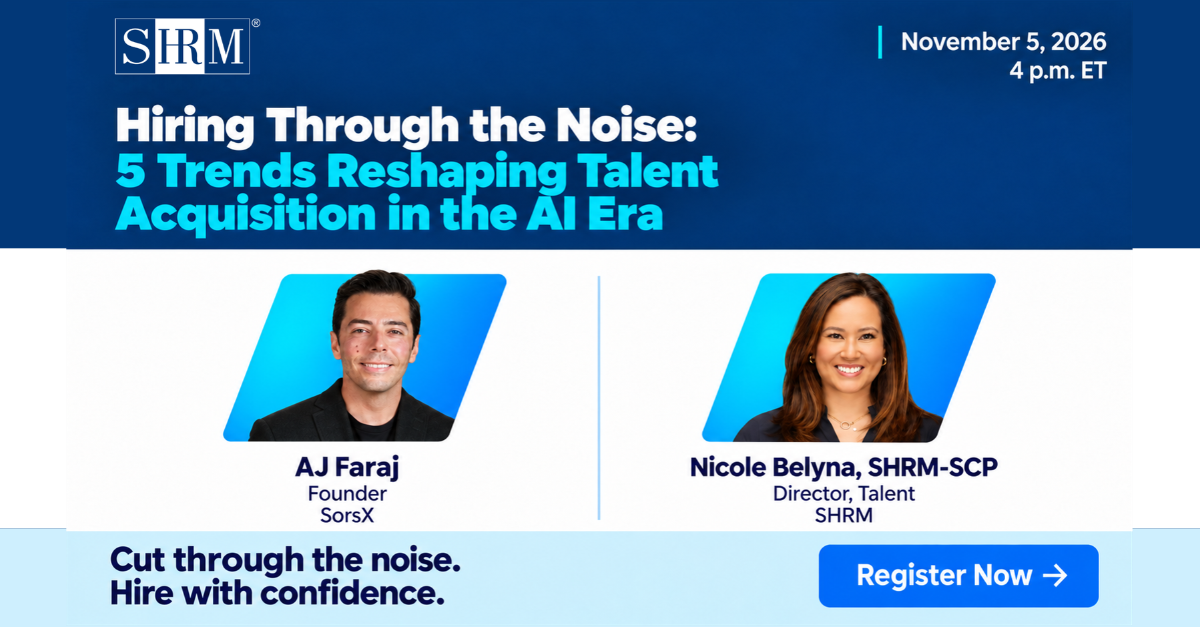
On November 5, 2026, at 4:00 PM ET, AJ Faraj, Founder of SorsX, will join Nicole Belyna, Director of Talent at SHRM, for a webinar titled Hiring Through the Noise: 5 Trends Reshaping Talent Acquisition in the AI Era.
The discussion will explore five emerging trends influencing recruitment and how organizations can prepare for the next generation of hiring.
The Growing Challenge: AI and the Talent Acquisition Signal-to-Noise Crisis
Generative AI has made it easier than ever for job seekers to create professional resumes, tailor cover letters, and apply to multiple positions.
For employers, this creates a complicated recruiting environment.
A polished resume no longer necessarily indicates that a candidate possesses the skills, experience, or capabilities required for a role.
At the same time, traditional recruitment processes often depend on manually reviewing applications, evaluating resumes, and conducting initial screening interviews.
As application volumes increase, these processes can become difficult to scale.
This challenge is sometimes described as a talent acquisition signal-to-noise crisis: hiring teams have access to more candidate information, but identifying the most meaningful indicators of talent can become harder.
To respond, employers need to reconsider how they source, assess, and engage candidates.
Here are five talent acquisition trends expected to influence hiring strategies in 2027.
1. Employee Referrals Are Becoming More Valuable
Employee referral programs have long played a role in recruitment, but their importance may increase as organizations look for additional ways to identify qualified candidates.
When employers receive large numbers of applications, referrals can provide an additional source of context about a candidate's professional background and capabilities.
A strong referral strategy can help organizations:
- Reach candidates through trusted professional networks.
- Discover qualified professionals who may not be actively applying.
- Reduce reliance on traditional job advertising.
- Create stronger connections between employees and recruitment teams.
However, referrals should complement structured assessments rather than replace them.
Organizations also need to ensure that referral-based recruitment does not unnecessarily narrow access to opportunities or reduce workforce diversity.
What this means for 2027: Companies may increasingly combine employee referrals with AI-powered talent sourcing to expand their candidate pipelines while maintaining consistent evaluation standards.
2. Skills-Based Hiring Is Replacing Resume-First Recruitment
One of the most significant talent acquisition trends is the shift toward skills-based hiring.
Traditionally, employers have relied heavily on educational qualifications, job titles, and previous employers to determine candidate suitability.
But these indicators do not always provide a complete picture of whether someone can succeed in a role.
Skills-based hiring places greater emphasis on demonstrable capabilities, relevant experience, and role-specific competencies.
Instead of asking only where someone has worked, hiring teams can focus on what that person can actually do.
Why skills-based hiring matters
Skills-based assessments can help employers:
- Evaluate job-relevant capabilities more consistently.
- Identify qualified candidates with unconventional career paths.
- Reduce overreliance on resume keywords.
- Create more structured candidate comparisons.
- Make better-informed hiring decisions.
For example, a manufacturing company recruiting CNC operators may benefit from assessing machine experience, technical drawing interpretation, and equipment knowledge rather than relying exclusively on resumes.
Similarly, a sales organization may prioritize communication skills, customer engagement, and sales experience through structured evaluations.
How AI supports skills-based recruitment
AI recruiting tools can help organize candidate information, support structured screening, and facilitate competency-focused interviews.
However, employers should evaluate whether these tools are accurate, job-relevant, accessible, and appropriately supervised.
What this means for 2027: Skills validation is likely to become an increasingly important component of recruitment strategies, especially as AI-generated resumes become more common.
3. Internal Mobility and Reskilling Are Becoming Strategic Hiring Priorities
Recruitment is not always about finding new employees.
In some cases, organizations already have individuals with the potential to fill emerging roles, but lack the processes needed to identify and develop them.
Internal mobility and reskilling strategies allow companies to match existing employees with new opportunities.
As technology changes job requirements, these approaches can help businesses adapt without depending entirely on external recruitment.
The benefits of internal talent development
Effective internal mobility strategies can:
- Help retain valuable employees.
- Reduce the need for external recruitment.
- Support workforce planning.
- Create new career development opportunities.
- Build organizational adaptability.
For HR leaders, the challenge is understanding which skills already exist within the workforce and which capabilities employees need to develop.
AI-powered talent management systems may help organizations map skills, identify development opportunities, and support internal job matching.
What this means for 2027: Talent acquisition and talent development will increasingly need to work together, connecting hiring decisions with long-term workforce planning.
4. Entry-Level Hiring Expectations Are Changing
Artificial intelligence is also reshaping expectations for early-career professionals.
As AI tools become capable of supporting tasks such as research, writing, data analysis, and administrative work, employers may reconsider the skills they expect from entry-level candidates.
Technical familiarity with AI tools may become valuable, but employers will also need to evaluate capabilities that go beyond automated outputs.
These include:
- Critical thinking and problem-solving.
- Adaptability and willingness to learn.
- Communication and collaboration.
- Ethical judgment.
- The ability to evaluate AI-generated information.
For recruiters, assessing potential rather than simply previous work experience may become increasingly important.
This creates an opportunity to rethink traditional entry-level recruitment practices.
What should employers prioritize?
Organizations can consider structured interviews, practical exercises, and assessments that evaluate how candidates approach unfamiliar challenges.
The objective should not be to expect junior professionals to possess senior-level experience.
Instead, employers can focus on identifying candidates with the foundational skills and learning potential needed to grow within the organization.
What this means for 2027: Early-career recruitment strategies may evolve to place greater emphasis on learning agility, practical skills, and responsible AI literacy.
5. Candidate AI vs. Recruiter AI: The Next Phase of Recruitment Technology
AI adoption is accelerating on both sides of the recruitment process.
Candidates increasingly have access to tools that help them prepare resumes, identify vacancies, and improve applications.
Meanwhile, employers are adopting AI recruiting software to manage candidate sourcing, screening, communication, and interviews.
This creates a new dynamic: AI tools are influencing both how candidates apply and how organizations evaluate them.
For talent acquisition teams, this raises important questions.
- How can employers distinguish demonstrated abilities from AI-assisted presentation?
- How should AI-generated application materials influence hiring decisions?
- And where should human judgment remain central to recruitment?
Finding the right balance between AI and human judgment
AI can support recruitment teams by automating repetitive tasks and organizing large volumes of candidate information.
However, hiring decisions require thoughtful evaluation, transparency, and appropriate human oversight.
Organizations should establish clear processes for evaluating candidates and regularly assess whether their recruitment technologies support fair, reliable, and job-relevant decisions.
What this means for 2027: The most effective recruitment strategies may be those that combine AI-powered efficiency with structured skills validation and accountable human decision-making.
How SorsX Is Helping Companies Navigate the Future of Hiring
As these talent acquisition trends continue to evolve, organizations need recruitment systems that help them identify and evaluate talent without adding unnecessary complexity.
At SorsX, we're building AI-powered hiring technology designed to make recruitment more efficient, scalable, and accessible.
Our platform brings together key stages of the hiring process:
- AI Talent Sourcing — Discover relevant candidates beyond existing job applications and expand talent pipelines.
- AI Candidate Screening — Organize and evaluate applicant information to help recruiters focus on promising candidates.
- AI-Powered Interviews — Conduct structured candidate interviews that help hiring teams assess role-relevant qualifications and experience.
- AI-First Applicant Tracking System — Manage candidates, applications, and recruitment workflows within a connected hiring platform.
By bringing these capabilities together, SorsX aims to help recruiters spend less time on repetitive administrative tasks and more time engaging with qualified candidates.
Our approach focuses on using AI to support better hiring decisions while keeping employers in control of the recruitment process.
Join SorsX Founder AJ Faraj at SHRM's Upcoming Talent Acquisition Webinar
To explore these trends further, SorsX Founder AJ Faraj will participate in an upcoming webinar hosted by SHRM, alongside Nicole Belyna, SHRM's Director of Talent.
Hiring Through the Noise: 5 Trends Reshaping Talent Acquisition in the AI Era
- Date: Thursday, November 5, 2026
- Time: 4:00 PM Eastern Time
- Speakers: AJ Faraj, Founder of SorsX, and Nicole Belyna, Director of Talent at SHRM
The webinar will examine how organizations can respond to AI-driven application volumes, evaluate emerging recruitment strategies, and identify priorities for talent acquisition over the next two to three years.
Participants will explore how employers can balance technological capabilities with skills validation and human judgment.
The webinar is approved for 1 SHRM Professional Development Credit (PDC) toward SHRM-CP or SHRM-SCP recertification.
Register for the Webinar on SHRM
Final Thoughts: Preparing Your Talent Acquisition Strategy for 2027
The future of recruitment will not be determined by AI adoption alone.
It will depend on how effectively organizations combine technology, skills assessment, workforce development, and human expertise.
As application volumes grow and candidate expectations evolve, employers have an opportunity to move beyond traditional recruitment models toward more structured, skills-focused hiring.
The five trends discussed in SHRM's upcoming webinar highlight important considerations for organizations preparing their talent acquisition strategies for 2027 and beyond.
At SorsX, we believe the goal of AI recruiting should not simply be to process more applications.
It should be to help organizations discover genuine talent, make better-informed decisions, and create more effective hiring experiences.
Want to explore how AI-powered sourcing, screening, and interviews can support your recruitment strategy?
Frequently Asked Questions
What are the biggest talent acquisition trends for 2027?
Five important trends to watch are employee referrals, skills-based hiring, internal mobility and reskilling, changing entry-level hiring expectations, and the increasing use of AI tools by both candidates and employers.
How is AI changing talent acquisition?
AI is changing how candidates prepare applications and how employers discover, screen, and assess talent. While AI can improve recruitment efficiency, organizations also need reliable methods to validate candidates' skills and maintain appropriate human oversight.
Why is skills-based hiring important?
Skills-based hiring helps organizations evaluate candidates according to job-relevant capabilities rather than relying primarily on degrees, previous job titles, or resume keywords.
What is the SHRM Hiring Through the Noise webinar?
It is a November 5, 2026 webinar featuring SorsX Founder AJ Faraj and SHRM Director of Talent Nicole Belyna. The session explores five trends influencing global talent acquisition and how employers can adapt recruitment strategies for the AI era.
How can AI recruiting software improve hiring?
AI recruiting software can help organizations discover candidates, organize applications, support screening, conduct structured interviews, and manage hiring workflows. Results depend on how effectively the tools are configured, evaluated, and integrated with human recruitment decisions.